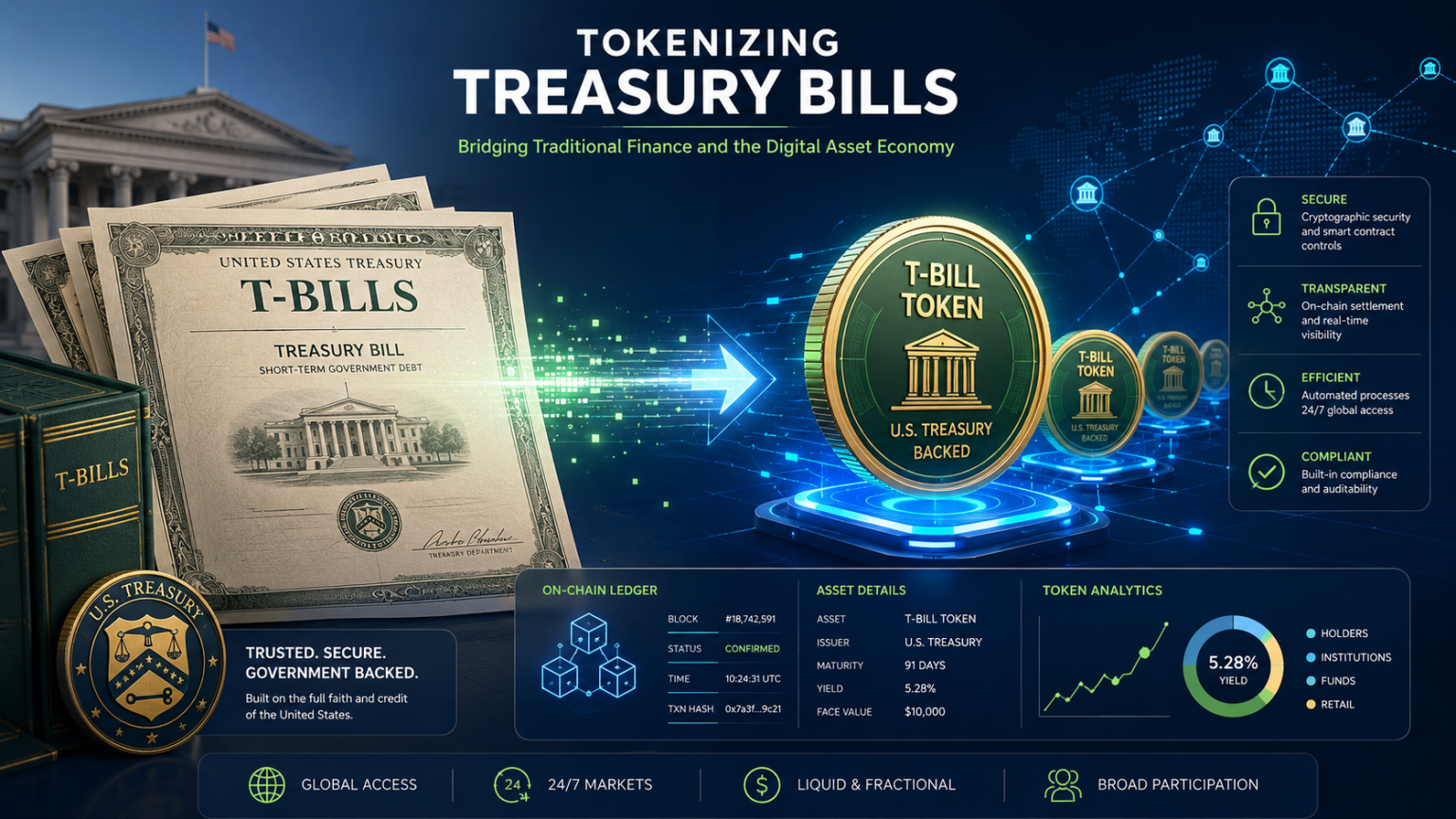

Tokenized Treasuries crossed $15 billion in on-chain value in early May 2026, and the largest asset manager on earth just pressed harder. On May 8, BlackRock filed with the SEC for two new tokenized funds, including on-chain shares of a roughly $7 billion money-market fund, per CoinDesk. Just weeks after its BUIDL fund cleared $2.5 billion. For a category that barely existed at scale three years ago, tokenized Treasuries have become the anchor the rest of on-chain finance is built on.
The T-bill got there first for a reason. It is the simplest thing in finance to put on a blockchain, and the market went where the work was easiest.
What tokenizing a Treasury actually does
Strip the jargon and a tokenized Treasury is a claim on short-term US government debt, recorded as a token on a public ledger anyone can audit. The underlying is still a T-bill, with the same issuer and credit risk behind it. What changes is the ownership record. It settles in about 30 seconds rather than the day or two of traditional clearing, divides down to the dollar, trades around the clock, and can be posted as collateral without leaving the chain.
The label hides a fork, though, and it matters for anyone reading past the headline. “Tokenized Treasury” describes two different legal structures. One is a regulated fund share where the blockchain is the official system of record – BlackRock’s BUIDL, Franklin Templeton’s BENJI, Superstate’s USTB. The other is a debt token issued by an offshore vehicle in the Caymans or BVI that holds the bills and redeems into a stablecoin – Circle’s USYC, Ondo’s USDY, OpenEden’s TBILL. They look alike on a screen. Their eligibility rules, redemption mechanics, and tax treatment are not.
The numbers, and the one most coverage skips
As of May 4, 2026, the tokenized Treasury market held $15.2 billion in distributed value across 76 products, according to RWA.xyz. The leaders by assets were Circle’s USYC at about $2.9 billion, BlackRock’s BUIDL at $2.6 billion, Ondo’s USDY at $2.1 billion, Franklin’s BENJI at $2.05 billion, and Centrifuge’s JTRSY at $1.24 billion.
One figure rarely makes the write-ups: 58,658 holders, at a blended seven-day yield of 3.36%, per RWA.xyz on the same date. Fifteen billion dollars spread across fewer than sixty thousand wallets is not a retail phenomenon. It is corporate treasuries, DAO reserves, and trading desks parking dollars in something that earns and settles instantly. Maker and Arbitrum are among the on-chain treasuries that have done exactly that.
The category is still the largest single slice of the real-world-asset market, though its dominance is easing. Tokenized Treasuries fell from 73.7% of the tokenized-RWA market to 67.2% over the fifteen months ending March 31, 2026, as other asset classes found traction, per CoinGecko. That is the market broadening, not the Treasury trade weakening. And the plumbing beneath it is going mainstream: Nasdaq, the NYSE, and the DTCC are all moving to fold tokenized securities into regulated-market infrastructure, while the SEC issued its first formal statement on tokenized securities in January 2026 and cleared intraday trading of WisdomTree’s tokenized money-market fund in February, per an InvestaX market report.
What the wrapper doesn’t fix
A token does not repeal interest-rate risk. Read that again. These products hold short-dated government debt, so if Treasury yields fall, the on-chain yield falls with them. The wrapper changes the settlement, not the duration.
The structural fork is the subtler trap. Ondo’s OUSG, for instance, is not literally a T-bill on a blockchain; it is structured exposure that can include money-market funds, per Ondo’s own SEC framing. Remember to always read the wrapper before assuming the risk. The tax surface is real too: digital-asset transactions report on Form 1099-DA starting with the 2025 tax year, so a tokenized bill is no paperwork shortcut.
Then there is the regulatory current pushing demand here in the first place. The GENIUS Act, signed in July 2025, bars interest payments on payment stablecoins. So, dollars that want a yield route into tokenized Treasuries instead. Part of this category’s growth is a side effect of a rule written for something else, and the act’s implementing regulations are not due until July 18, 2026. The frame is still being drawn.
Why the easy asset matters
Treasuries were tokenized first because they are the path of least resistance: uniform, liquid, legally unambiguous. That’s the feature point, not a limitation. Proving the rails on the cleanest asset builds the collateral layer and the credibility everything messier will borrow from. Whoever standardizes this infrastructure now, and the Nasdaq–NYSE–DTCC bloc intends to, sets the terms for all assets that follow.
This is where the series starts: with the asset that fits the wrapper perfectly. The harder questions arrive when the underlying stops cooperating. What about when it’s a building, or a restored watershed, that does not trade like a bill and does not sit neatly in a Cayman SPV.
The T-bill was the easy part. Tokenization has already proven it can wrap the most liquid asset on earth. The real test is whether the same machinery holds when the thing underneath has a coastline, a forest, or a living community attached to it. That is the rest of this series.
Disclosure: The author holds no position in the assets or companies named and has no relationship with them. This article is for informational purposes only and does not constitute financial advice.