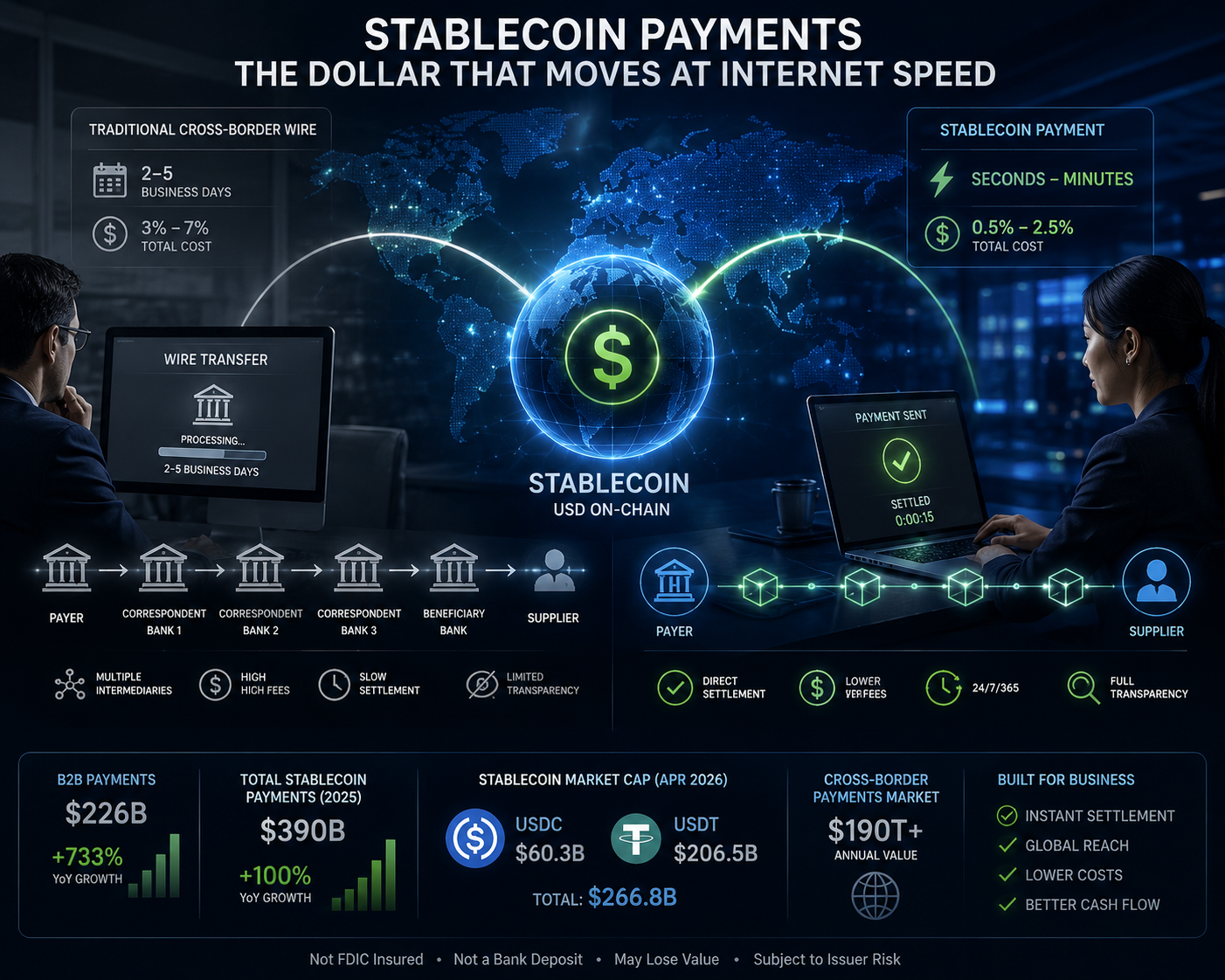

Stablecoin payments have found their killer app, and it is the least glamorous corner of finance: a company in one country paying a supplier in another. Business-to-business stablecoin payments jumped 733 percent over the past year to about $226 billion, roughly 60 percent of all stablecoin payment volume, per McKinsey. Total end-user payment activity reached around $390 billion in 2025, more than double the year before, again per McKinsey. The dollar, in other words, has quietly learned to settle across borders in seconds instead of days, and businesses noticed first.
This is not retail crypto speculation. It is back-office plumbing, and that is exactly why it is working.
What a Stablecoin Payment Actually Does
Strip the jargon and a stablecoin is a token that holds a steady value, almost always one US dollar, issued on a public blockchain. USDC and USDT are the two that dominate, together worth about $266.8 billion in circulation as of April 2026, per DeFiLlama. A stablecoin payment moves that dollar-token directly from payer to payee on the blockchain, settling in seconds, any hour of any day, without routing through a chain of correspondent banks.
The contrast with a traditional cross-border wire is the entire pitch. A standard international transfer moves through correspondent banks that each add a fee and a delay, taking two to five business days and costing anywhere from 3 to 7 percent of the transfer, per industry estimates compiled in 2026. The stablecoin version settles in minutes and costs closer to 0.5 to 2.5 percent. For a business moving money across borders every week, that gap is not a rounding error. It is working capital.
Why B2B Went First
Consumers were supposed to be the stablecoin story. Instead, corporate finance departments got there first, because they felt the pain most. In a 2025 EY-Parthenon survey, 77 percent of corporates named cross-border supplier settlement as their top reason to adopt stablecoins. The savings are concrete: Indonesian manufacturers have reported 73 percent cost savings settling in stablecoins versus traditional letters of credit, and Indian IT firms billing US clients report cash arriving 67 percent faster, per market analyses in 2026.
The infrastructure filled in around them. Visa settled $4.5 billion in stablecoins on an annualized basis as of January 2026 and has moved card-linked programs from pilot to production. Stripe, Shopify, and payment platform BVNK built stablecoin rails into their products, and Western Union and MoneyGram, the old guard of remittances, launched USDC settlement corridors across 25 markets rather than fight the technology. The signal there is worth pausing on: the incumbents are converging with blockchain rails, not being replaced by them.
What the Wire Still Does Better
The friction lives at the edges, where dollars become tokens and back again. A stablecoin payment is fast in the middle, but someone still has to convert local currency into the token at one end and out of it at the other, and those on and off-ramps are where fees, delays, and compliance checks quietly return. In a thin-liquidity currency, the ramp can cost more than the wire it replaced.
The rulebook is still being written. The GENIUS Act, the 2025 federal law governing payment stablecoins, is being implemented through proposed rules issued in early 2026 by the OCC, the FDIC, and the Treasury, setting reserve, redemption, and anti-money-laundering standards and barring issuers from paying interest. Europe’s MiCA framework is already operational. And a point businesses often miss: the FDIC proposed in April 2026 that dollars held as reserves behind a stablecoin are not insured to the people holding the coin. A stablecoin is a claim on its issuer, not a bank deposit, and the issuer’s soundness is the risk you actually carry.
Why It Matters
Underneath the efficiency story is a bigger one: the dollar is being unbundled from the American banking system. For most of modern history, holding and moving dollars meant going through a US bank or its correspondents. A stablecoin lets a business in Jakarta or Lagos hold and send dollars without touching that system at all, on a network that never closes. The cross-border payment market is roughly $190 trillion a year, and even a small share of it shifting to stablecoin rails reshapes who clears the world’s dollars.
That reach is the promise and the complication. Cheaper dollars reaching businesses long underserved by correspondent banking is a genuine gain. But a world that runs on privately issued dollar-tokens also concentrates enormous power in a handful of issuers, and it deepens the dollar’s grip on economies that may want their own monetary footing. Those questions get sharper the closer this series moves to the people for whom the dollar is a lifeline and a dependency at once. The next installment follows the money home, to remittances.
The wire transfer had a fifty-year head start and still takes three days. Stablecoin payments closed that gap not with a better bank but with a different kind of dollar, one that moves like data and answers to code. Whether that is progress or just a faster version of an old dependence depends on where you sit, and on who issues the dollar you are holding. For a business waiting on a cross-border invoice, the answer is already obvious. For everyone else, it is the question this series is about to unfold.
Disclosure: The author holds no position in the assets or companies named and has no relationship with them. This article is for informational purposes only and does not constitute financial advice.