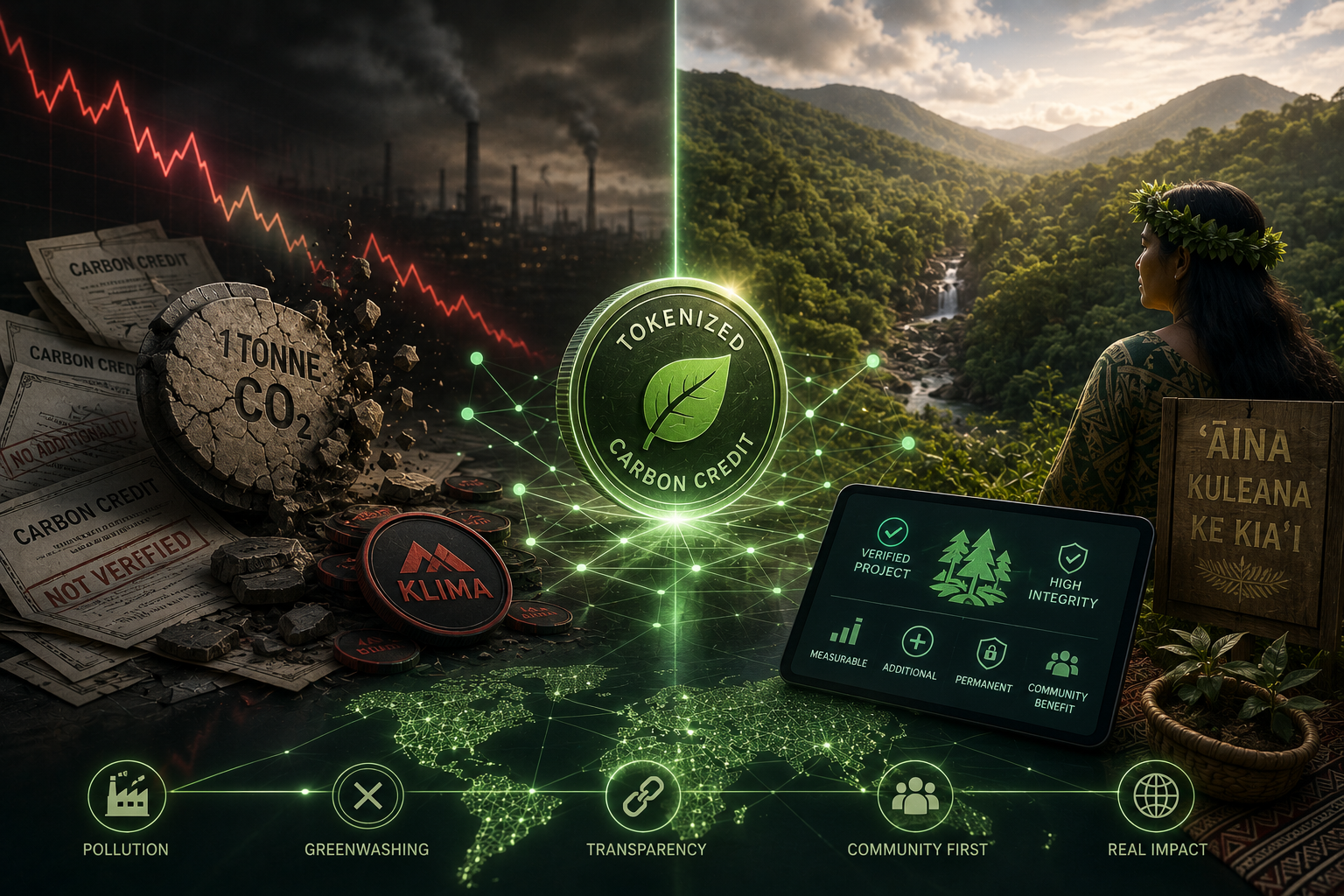

Tokenized carbon credits were the first crypto experiment to promise it would help save the planet, and the first to show how badly that could go. KlimaDAO’s KLIMA token, each unit backed by a tonne of carbon, peaked near $3,946 in October 2021 and traded around $0.04 by March 2026, a fall of more than 99 percent, per coinpaprika. The idea did not die with the token. In July 2025, JPMorgan launched a carbon-credit tokenization service through its Kinexys unit, per Polaris Market Research, and the second wave looks nothing like the first.
A tonne of carbon is easy to tokenize. Proving the tonne exists is the whole problem.
What Tokenizing a Carbon Credit Actually Does
Strip the jargon and a carbon credit is a certificate that one tonne of carbon dioxide was kept out of the atmosphere, or pulled from it, by some project: a protected forest, a methane capture, a reforestation plot. Tokenizing it runs in a specific order. The holder retires the credit in a traditional registry like Verra, which marks it used so it cannot be sold again, and a protocol such as Toucan then mints a matching token on-chain. Toucan’s Base Carbon Tonne, or BCT, pools any eligible Verra credit; its Nature Carbon Tonne accepts only nature-based projects, and sells at a premium for it.
The appeal is legitimate. A carbon market that has run for decades on brokers and opaque pricing gets a public ledger where anyone can see what a credit is, what it cost, and whether it has been retired. That transparency is the honest case for putting carbon on-chain, and it is a good one.
A Boom, a Bust, and a Quieter Return
The first wave, in 2021, was a gold rush. Toucan’s bridge let anyone turn registry credits into tradeable tokens, KlimaDAO offered high yields to lock them up, and BCT jumped from a few dollars into a speculative frenzy. Then the flaw showed. The bridge was accepting old, cheap credits from projects with little climate benefit at all, the ones that could not sell in normal markets, and giving them fresh on-chain liquidity. Researchers at CarbonPlan called them zombies on the blockchain: dead credits walking, revived by crypto demand.
Verra, the largest registry, halted tokenization of retired credits in May 2022 to protect its market, and as of early 2026 had still not finalized a replacement framework. The speculative version collapsed with the rest of the 2022 market. What is returning is slower and more institutional: JPMorgan’s Kinexys service, an IFC carbon fund, and registries building their own rails, aimed at transparency rather than yield. Market researchers size the tokenized-carbon segment near $4.5 billion in 2025, a figure that, like most projections in this space, assumes a future that has not arrived.
What the Token Doesn't Fix
Tokenizing a bad credit produces a bad token. The blockchain records that a credit was retired and bridged; it cannot judge whether the underlying project ever removed the carbon it claimed. That judgment happens off-chain, in forests and soil and satellite data, and the voluntary carbon market’s long crisis is precisely that so many credits do not hold up to it. Investigations have found large tranches of rainforest offsets that protected nothing. Putting them on-chain changes their packaging, not their substance.
Permanence is the harder version of the same gap. A token representing a tonne stored in a standing forest depends on that forest standing, and a wildfire, a chainsaw, or a change of government can release the carbon while the token trades on, backed by nothing. The market has started paying premiums for high-integrity credits, which is progress, but no amount of tokenization verifies the tonne. It only records the claim.
Why It Matters
Carbon is where this series stops dealing with money and starts dealing with land, and with the people who have kept that land alive. A carbon credit turns a living ecosystem into a single fungible number: one tonne, interchangeable with any other. That abstraction is what makes the credit tradeable, and it is also what makes it dangerous, because a forest is not fungible, and neither is the community that depends on it.
A large share of the world’s nature-based credits are generated on Indigenous and rural lands, and the value has a long habit of flowing somewhere else. Critics call it carbon colonialism: outside buyers booking the climate benefit of a forest while the people who live in it see restrictions rather than returns. Tokenization can cut either way. Routed to the stewards, it could pay communities directly for protection they already provide. Routed around them, it adds a speculative financial layer to land they never agreed to sell the sky above.
The Kanaka Maoli relationship to ʻāina names the alternative directly. In that framework, land is not an asset to be optimized but a relative to be cared for, a kuleana, a responsibility that runs in both directions between people and place. Stewardship traditions like it have held ecosystems intact for centuries without pricing them by the tonne. The question tokenized carbon forces is whether a market can pay for that care without dissolving the relationship that produces it. The next and final installment of this series meets that question head-on, in tokenized natural capital.
The first tokenized carbon boom failed because it treated a broken market as a technology problem, and code cannot fix a credit that was never real. The second wave is more careful, and more honest about verification, which is genuine progress. But the deeper issue is not whether the tonne is real. It is whether a tonne is the right unit for a forest at all, and who gets to decide. That is the question the whole series has been walking toward, and it is where the series ends next.
Disclosure: The author holds no position in the assets or companies named and has no relationship with them. This article is for informational purposes only and does not constitute financial advice.