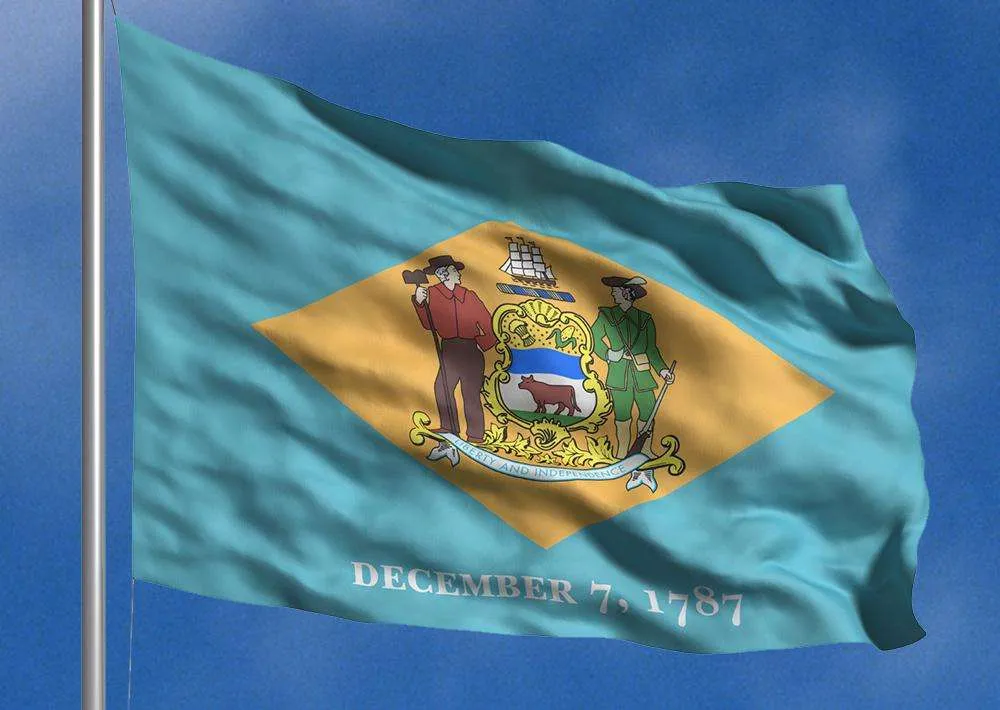

Delaware crypto policy has a paradox at its core. The state that wrote the first law in the country to put company shares on a blockchain, back in 2017, is now watching crypto companies leave and the tokenized-stock boom it once envisioned get built almost everywhere else. Coinbase reincorporated in Texas in late 2025. The tokenized equities Delaware’s own law anticipated trade out of Liechtenstein and Lithuania.
The exits are real, if not yet a stampede. In 2025, roughly 28 public companies formally left Delaware, among them Tesla, SpaceX, and Coinbase, whose chief legal officer said the state left it little choice. Delaware’s share of U.S. initial public offerings fell from as high as 93% over the past decade to about 62% in 2025, with Nevada and Texas taking most of the rest. This is not a rounding error for the state. Its incorporation franchise throws off about $2.2 billion a year in franchise taxes, close to a third of Delaware’s budget.
Delaware fought back. In 2025 it passed Senate Bill 21, a package of corporate-law amendments that critics nicknamed the Billionaire’s Bill, meant to restore predictability for controlling shareholders and slow the departures, and the state Supreme Court upheld the changes. The crypto-native pull runs the other way, though. Wyoming offers digital-asset clarity and a DAO statute, Texas and Nevada offer lower costs and friendlier courts, and Coinbase, Andreessen Horowitz, and others took the door.
The Head Start Delaware Isn't Using
Here is the irony. Delaware saw this coming eight years early. In 2017, it amended its General Corporation Law to let companies issue and transfer stock directly on a blockchain, with the token itself serving as the share of record. The state wrote the statute for on-chain ownership before the market for it existed.
That market exists now. Tokenized stocks reached roughly $1.8 billion on-chain in 2026, and Backed’s xStocks alone crossed $25 billion in cumulative trading volume after launching in mid-2025. Robinhood switched on more than 200 tokenized equities for European users and launched its own blockchain to settle them in July 2026. Almost none of it uses Delaware’s distributed-ledger-share law. The dominant products are synthetic wrappers: a token that tracks a share’s price, backed one-to-one by stock a custodian holds, issued under a Liechtenstein prospectus or a Lithuanian license. Many convey no shareholder rights at all. Robinhood’s are structured as debt securities, a design the SEC flagged for scrutiny in January 2026.
The Franchise Was Never the Incorporations
That gap is the whole story. The hard part of tokenizing a stock, as the SpaceX tokens showed during its June 2026 IPO, is not minting the token. It is securing a clean legal claim to the real underlying share, which is precisely the problem Delaware corporate law was built to solve. Delaware could be the jurisdiction where a token is the share, with voting and dividends and legal recourse attached, instead of a derivative pointing at one from a distance. Its 2017 law already allows it. What it lacks is the companies, the tooling, and the will to make the on-chain share a Delaware product before the definition of ownership settles somewhere else.
Delaware has spent a century as the place where American ownership is defined, and it collects nearly a third of its budget for the service. Tokenization is the first real change to how ownership gets recorded since the paper stock certificate, and Delaware wrote the first law for it, then let the market route around the state and its companies drive across the border. The franchise was never really the incorporations. It was being the authority on what a share is. That authority is being rewritten on-chain right now, and Delaware is not yet in the room.
Disclosure: The author holds no position in the assets or companies named and has no relationship with them. This article is for informational purposes only and does not constitute financial advice.