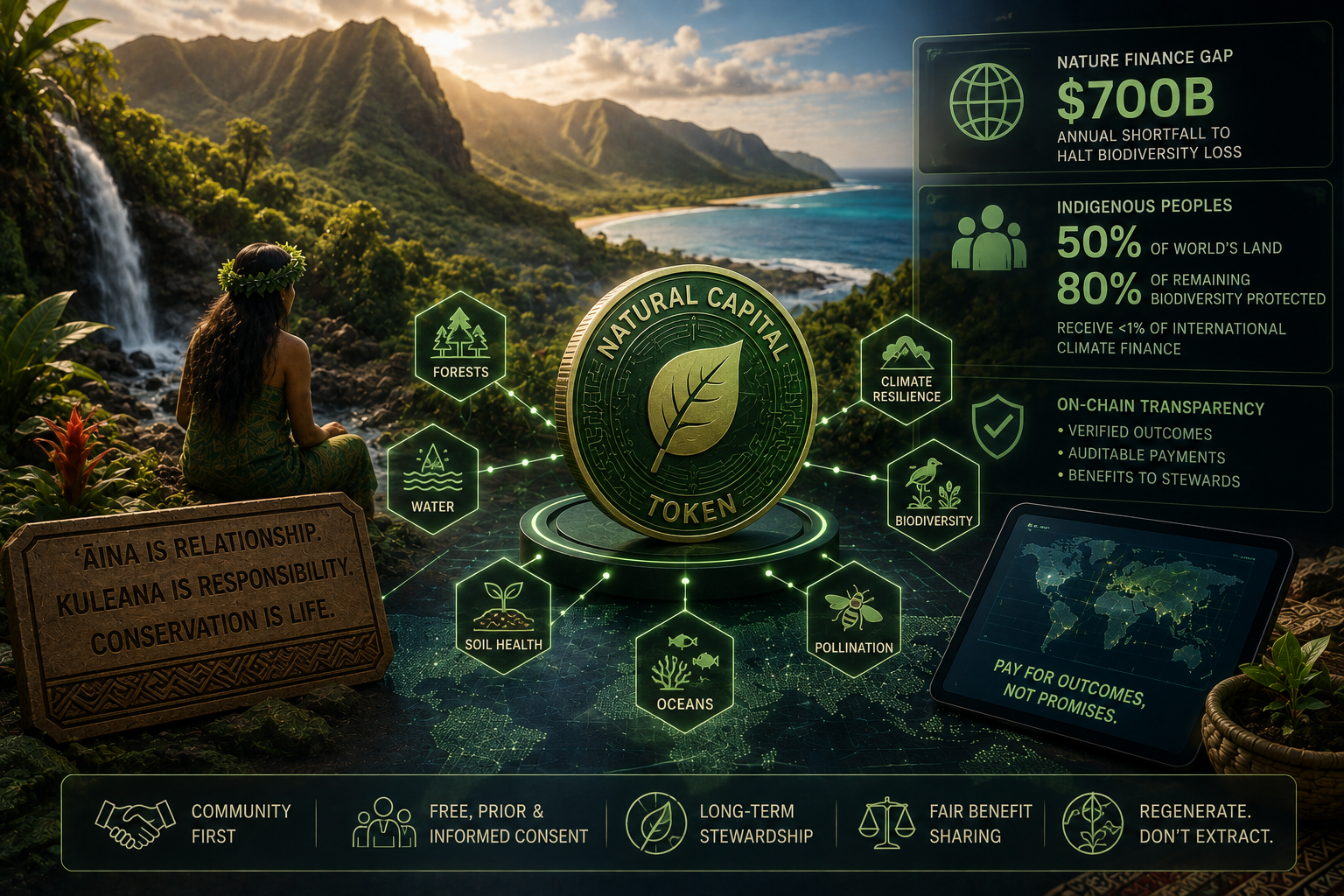

Natural capital tokenization is the destination this entire series has been climbing toward, and the place where the whole project of tokenizing meets its hardest test. The idea is to take the living systems that keep the planet running, forests, reefs, watersheds, soil, and turn measured conservation into a tradeable on-chain asset, so that protecting a wetland can pay the way draining it does. The money is there in theory: the UN Environment Programme puts the annual shortfall for halting biodiversity loss near $700 billion. The willingness is more complicated. When the New York Stock Exchange tried to list nature as an asset class, the plan collapsed inside months.
Every earlier installment asked whether the token matched the asset. This one asks whether the asset should be a token at all.
What Tokenizing Natural Capital Actually Does
Strip the jargon and natural capital is the stock of nature that does economic work: a forest that stores carbon and filters water, a reef that breaks storms and feeds fisheries, soil that grows food. Tokenizing it means turning a verified conservation or restoration outcome, a protected watershed, a recovering species population, into a token that funds the work by paying for results rather than promising effort. Regenerative finance, or ReFi, is the umbrella term, and its pitch is a durable revenue stream for conservation where today there is mostly episodic grant money.
This goes a step past carbon. A carbon credit reduces everything to one number, the tonne. Natural capital is broader and messier: biodiversity, water, pollination, soil health, none of which collapses into a single clean unit. That breadth is the appeal, because it captures more of what nature does, and it is also the trap, because the harder a thing is to measure, the easier it is to fake.
A Market Being Built, and the One That Blew Up
The market is early and mostly aspirational. Analysts size biodiversity and natural-capital credits near $5.7 billion in 2024, and the policy scaffolding is going up: the 2022 Kunming-Montreal framework committed the world to protecting 30 percent of land and sea by 2030 and mobilizing $200 billion a year for nature. New Zealand launched a government-backed biodiversity credit scheme in 2026; a Swiss town issued a local biodiversity voucher pegged to the franc. ReFi platforms like Regen Network and Single.Earth have been tokenizing ecological outcomes for years.
Then there is the cautionary tale. In 2021 the New York Stock Exchange, with a company called Intrinsic Exchange Group, proposed Natural Asset Companies: publicly listed firms that would hold the rights to the ecological performance of a piece of land and monetize it. It was the most ambitious attempt yet to make nature an asset class. It was withdrawn in January 2024, weeks after a coalition of 25 state attorneys general and members of Congress attacked it as a scheme to let Wall Street control public, private, and tribal land, in some readings without the landowners’ consent. The technology was never the problem. The question of who controls the land, and who agreed, is what killed it.
What the Token Can't Measure
The measurement problem is not a detail; it is the whole difficulty. Carbon at least has a unit. Biodiversity has no agreed way to price a species, a wetland, or an intact reef, and without shared metrics a credit means whatever its issuer says it means. A 2026 review in the journal Oryx warned that biodiversity credits could cut both ways: a genuine funding tool, or a distraction that lets governments offload onto voluntary markets the nature commitments they signed.
Permanence and additionality carry over from carbon: a token is only as good as the protection lasting and the protection being genuinely new. But natural capital adds a deeper flaw the earlier assets mostly avoided. A Treasury or a bond is a claim by design. A forest is not a financial instrument that happens to live outdoors; it is a place, with a history and often with people, and turning it into a fungible credit strips exactly the context that makes it worth protecting.
Whose Nature, and on Whose Terms
Here is the fact that should anchor the entire conversation. Indigenous peoples steward roughly half the world’s land and protect about 80 percent of its remaining biodiversity, and they receive less than 1 percent of international climate finance, per reporting from Reuters in 2023. The nature that natural capital tokenization wants to fund is, overwhelmingly, nature someone is already keeping alive, usually without payment and often on land taken or contested. Any honest version of this market has to begin there.
For those of us in the Pacific, the alternative model is not theoretical. Hawaiʻi holds 27 of the 38 Holdridge life zones on Earth, a concentration of ecological range found almost nowhere else, and it survived not because anyone priced it but because of a relationship the market has no column for. In the Kanaka Maoli understanding, land is ʻāina, that which feeds, and the bond between people and place is kuleana: a responsibility that runs both ways and cannot be sold. Ecosystems held under that ethic have lasted centuries. The ledger did not invent stewardship. It arrived very late to it.
That history points to where tokenization genuinely helps, and where it does harm. The honest role for a public ledger in natural capital is record integrity: proving who stewards a place, tracking whether a payment for protection reaches the community doing the protecting, making benefit-sharing auditable instead of promised. That is a real contribution, and a modest one. The dishonest version is the one that keeps recurring, pricing a people’s land as a tradeable asset, listing it somewhere far away, and calling the proceeds conservation. Natural Asset Companies were that second version wearing a green suit, and the land’s stewards were the last to be asked.
Eleven installments ago, this series opened with a tokenized Treasury, the simplest asset there is: uniform, liquid, owned by no one in particular. It ends with the hardest, a living system owned in the deepest sense by everyone and no one, and cared for by specific people the financial system has spent centuries overlooking. Tokenization can carry a claim on almost anything now. The unfinished question, the one no smart contract answers, is which things should be claims at all, and who holds the right to decide. Nature will keep doing its work while the market argues. The people who have kept it alive deserve to be more than a line item in the answer.
Disclosure: The author holds no position in the assets or companies named and has no relationship with them. This article is for informational purposes only and does not constitute financial advice.