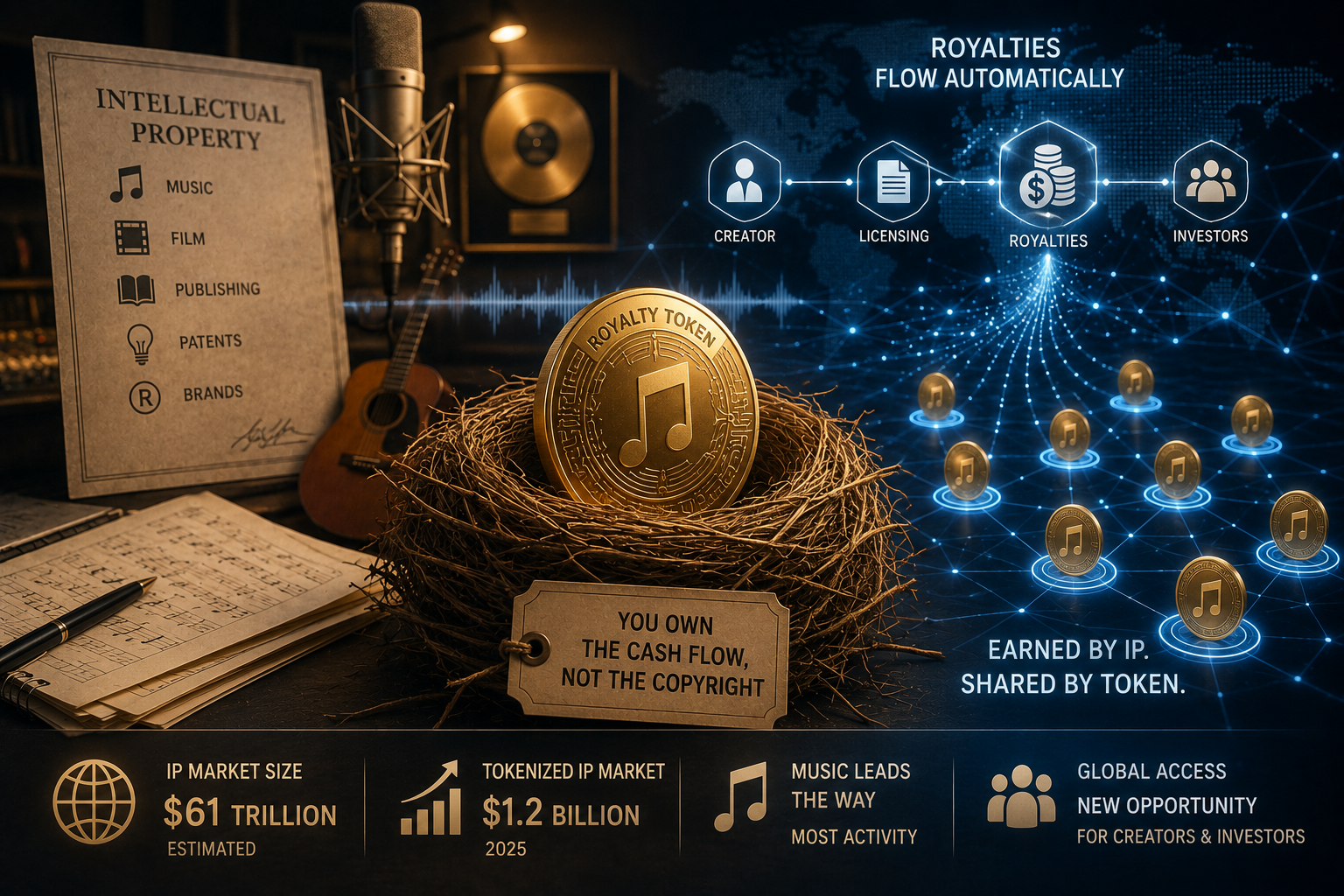

Tokenized royalties are aimed at the biggest and least-tokenized target in finance. Intellectual property, the songs, patents, and brands carried on balance sheets as intangible value, is worth an estimated $61 trillion, more than ten times the entire crypto market, per figures cited by the Story Foundation, and only about $1.2 billion of it has been tokenized, per coinpaprika. The royalty token is the wedge trying to close that gap, and it comes with a distinction worth understanding first: you buy the income, not the intellectual property.
A royalty token is a claim on a cash flow. It is not the copyright, the patent, or the song.
What Tokenizing a Royalty Actually Does
Strip the jargon and a royalty token is a share of the future income an IP asset throws off: a slice of a song’s streaming payments, a patent’s licensing fees, a catalog’s synchronization deals. Mint 10,000 tokens against a track and each one carries a fixed fraction of what that track earns, distributed automatically by smart contract as the money arrives, per Chainlink. The pitch is speed and access. Where a songwriter can wait months for a collecting society to route a payment, an on-chain royalty settles as it lands, and a fan can hold a piece of a catalog that used to be reserved for labels and funds.
Story, a blockchain built specifically for intellectual property, takes this further: its programmable license routes royalties automatically through chains of derivative works, so a remix or a sample pays the original without a lawyer renegotiating each time. That is the genuine advance here. The friction it removes, the intermediaries and the delay, is real and expensive.
A Trillion-Dollar Target and a Rounding-Error Market
The size gap is the widest in this entire series. IP tokenization was about $1.2 billion in 2025 and is projected to reach $3.7 billion by 2030, per coinpaprika, against that $61 trillion of intangible value. The activity is concentrated in music. Aria, built on Story, launched a token in February 2025 carrying royalties from songs by Justin Bieber, Miley Cyrus, BLACKPINK, and BTS, funded with $10.95 million, and raised $15 million at a $50 million valuation that September. Smaller platforms tier by access: Royal has paid royalty streams in stablecoins since 2021 from $50, anotherblock sells from 99 euros, SongVest runs SEC-registered offerings from $100.
The law has caught up with the obvious. In January 2026, an SEC joint staff statement confirmed that a revenue-sharing IP token meeting the Howey test is a security, blockchain wrapper or not. In practice that means most royalty tokens are gated to accredited or region-restricted investors, the same fence that runs through every other asset in this series.
What the Token Doesn't Own
The token and the asset are two different things, and the distance between them is where the risk lives. You hold a claim on income; the copyright, patent, or trademark stays with whoever registered it. If those rights are disputed, revert to the creator under copyright-termination law, or simply expire, the cash flow your token depends on can thin or vanish while the token itself sits unchanged on-chain.
Yield is the other exposure. A royalty token pays only what the underlying earns, so its value tracks streaming performance and public taste, neither of which a smart contract controls. The automation works; the income it automates is a bet on culture. Buying a catalog token is closer to backing a portfolio of songs than to clipping a bond coupon.
Why It Matters
Royalties are where tokenization stops dealing in money and starts dealing in culture, and that is a harder thing to put in a box. The model assumes intellectual property is individually owned and freely tradeable, which is true of a pop catalog and false of a great deal of the world’s creative heritage. Indigenous songs, chants, designs, and knowledge, including Hawaiian mele and oli, are frequently communal and intergenerational, held by a people rather than a person and not meant to be sold away from the community that carries them.
Western IP law has always fit those forms badly; the first WIPO treaty extending protection to traditional knowledge and genetic resources was adopted only in May 2024. Tokenization sharpens that question rather than settling it. Done well, it could let an individual Native creator capture value directly, routing income around the labels and intermediaries that have long taken the largest cut. Done carelessly, it turns communal heritage into one more tradeable instrument, priced and sold by whoever tokenizes it first. The technology is neutral on which happens. The people who hold the culture are not.
Tokenized royalties are the most abstract asset this series has reached: no bar in a vault, no building, no invoice, just a claim on what a song might earn next year. That abstraction is what makes the technology elegant and the stakes easy to miss. Turning income into a token is a solved problem. Deciding whose culture becomes a tradeable asset, and on whose terms, is not. The series turns next to an asset where that question is the entire point, the tokenized carbon credit.
Disclosure: The author holds no position in the assets or companies named and has no relationship with them. This article is for informational purposes only and does not constitute financial advice.